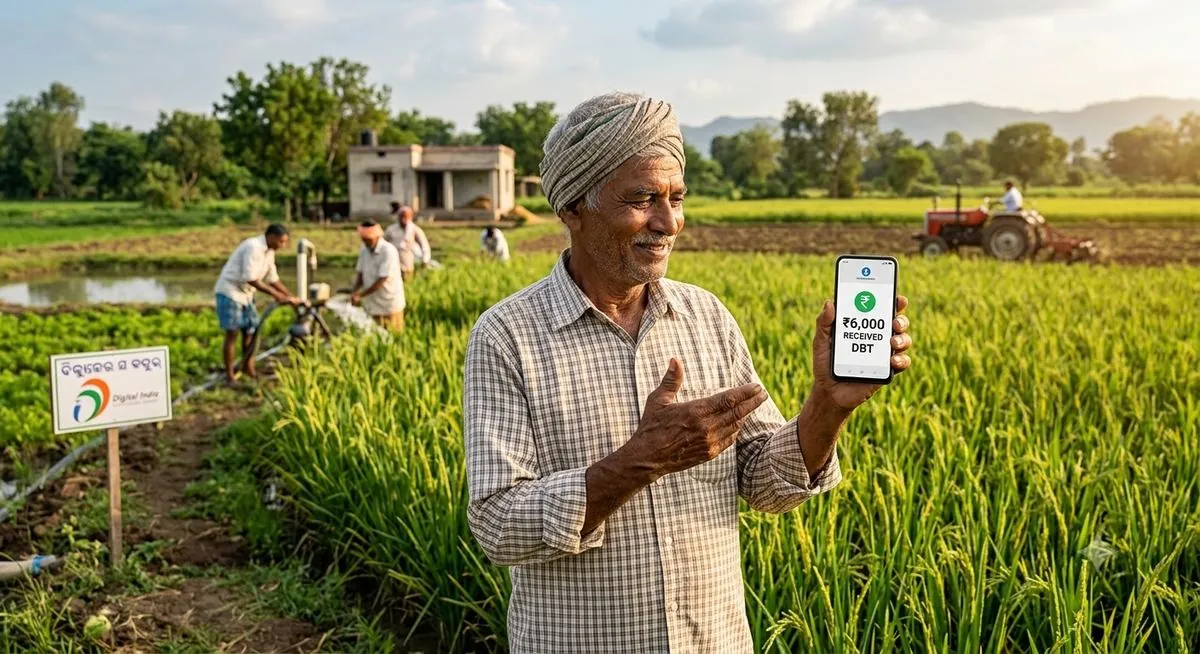
India has extended its flagship PM-KISAN income support programme for another five years, committing ₹3.15 lakh crore (about US$33.2 billion) to continue direct cash transfers to millions of farmers through the 2030-31 financial year.
The world’s most populous nation approved the extension to ensure that eligible landholding farmer families continue to receive ₹6,000 (about US$63) a year in three equal instalments paid directly into their bank accounts through the Direct Benefit Transfer (DBT) system.
The decision keeps one of the world’s largest cash transfer programmes in place at a time when India is seeking to raise farm incomes, strengthen rural demand and expand the use of digital public infrastructure to deliver welfare benefits. The extension also reflects the growing role of Digital India infrastructure in delivering welfare programmes. By combining Aadhaar authentication, digital beneficiary verification and the DBT network, PM-KISAN has become a key example of how technology is being used to transfer public funds directly to citizens.
The Pradhan Mantri Kisan Samman Nidhi (PM-KISAN) Scheme, introduced in 2019, uses Aadhaar-based authentication and digital verification to transfer funds directly to beneficiaries, reducing intermediaries and delays in payments. The government said the programme currently reaches nearly 9.5 crore (95 million) farmers, reinforcing its push to deliver welfare through digital platforms.
“The approval reiterates the government’s commitment that the prosperity of farmers forms the foundation of the nation’s prosperity. Through the PM-KISAN Scheme, timely and transparent income support is being provided to eligible farmer families through the Direct Benefit Transfer (DBT) system, enabling farmers to increase agricultural investment and strengthen their livelihoods,” the Ministry of Agriculture & Farmers Welfare said in a statement.
“The PM-KISAN Scheme is an excellent example of the effective use of Digital India. Through Aadhaar-based authentication, digital beneficiary verification and the DBT system, financial assistance is being transferred directly to farmers,” it added.
Financial aid reaches 95 million farmers
More than ₹4.47 lakh crore (about US$47.1 billion) has been transferred under the scheme across 23 instalments since its launch, according to the government. In the latest instalment, more than ₹18,984 crore (US$2 billion) was credited to over 9.49 crore (95 million) farmers.
The Ministry said the financial support helps farmers buy seeds, fertilisers, irrigation equipment and other farm inputs on time, while reducing their dependence on informal borrowing.
The government cited an evaluation by NITI Aayog’s Development Monitoring and Evaluation Office, which found that more than 92% of beneficiaries used the assistance for agricultural activities or farm investment. About 85% reported higher agricultural income and lower reliance on informal credit. NITI Aayog is the primary policy advisory group and think tank of the Indian government.
Agriculture remains a major source of employment in India, and support programmes such as PM-KISAN are seen as an important safety net for rural households. By extending the scheme by five years—from 2026-27 to 2030-31—India is providing longer-term certainty for millions of farmers while reaffirming its focus on digitally delivered welfare and agricultural investment.
“The continued expansion of the PM-KISAN Scheme will enhance farmers’ capacity to invest in agriculture, improve productivity, help reduce agricultural risks and strengthen the rural economy,” the Ministry said in the statement.
“The PM-KISAN Scheme is an important pillar of the government’s farmer-centric policies. The Scheme is aimed at empowering the country’s food producers, thereby strengthening their role in India’s journey towards Viksit Bharat (Developed India),” it added.