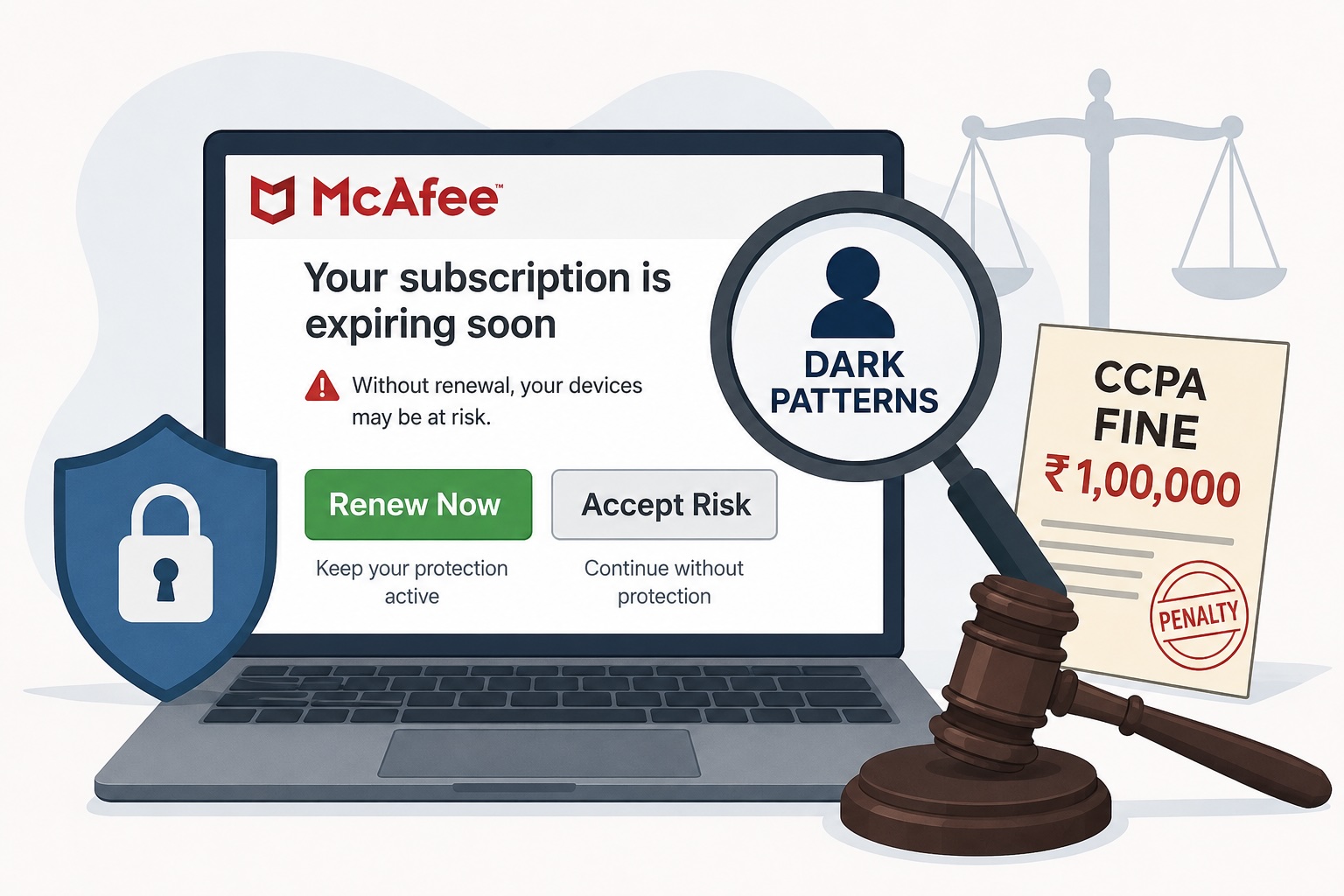
India's consumer protection regulator has stepped up its action against manipulative online design practices, slapping a penalty of ₹1 lakh (about USD1,050) on McAfee Software India Private Limited for subscription renewal prompts that allegedly pressured users through fear-based messaging. The move underscores the regulator's growing focus on ensuring digital platforms allow consumers to make informed choices free from deceptive interface tactics.
India's Central Consumer Protection Authority (CCPA) has imposed penalties on digital security provider McAfee Software India Private Limited, for using "dark pattern practices" which it claimed misled consumers and influenced their choices on digital platforms.
After reviewing McAfee's subscription renewal interface, the CCPA said that users were not presented with a balanced or neutral choice. Instead, the platform highlighted two options — "Renew Now" and "Accept Risk" — which framed consumers' decision not to renew subscriptions as potentially unsafe.
The regulator said the wording implied that customers could face cybersecurity dangers if they allowed their subscriptions to lapse, a claim the company could not definitively support. According to the CCPA, this design approach had the effect of nudging consumers toward renewal rather than allowing them to make an unbiased decision.
The CCPA, which is headed by Chief Commissioner, Nidhi Khare, and Commissioner, Anupam Mishra, said: "CCPA noted that consumers should be able to make subscription decisions freely and without fear-based messaging or misleading design elements. The Authority found that the renewal interface used deceptive practices that could influence consumer decisions and amount to unfair trade practices."
As a result, McAfee has been fined ₹1 lakh (about USD1,050) and has been directed to remove such practices from its platform to ensure that consumers are able to make informed choices without pressure or manipulation. The company has also been directed to ensure that no dark patterns are employed on its platform, website, application or any other digital interface.
Why it matters?
The order marks an important development in India's efforts to curb deceptive design practices in the digital marketplace. Beyond the penalty imposed on McAfee, the decision sends a broader message to online businesses that consumer choices must not be shaped through fear, confusion, or interface designs that steer users toward a preferred outcome. Companies may now face greater scrutiny over how they present pricing, subscription renewals, cancellation options, and other key decisions that affect consumers.
Although the ₹1 lakh fine does not result in direct compensation for affected users, the larger significance lies in the regulator's directive to eliminate the disputed practices and its willingness to enforce the country's dark pattern rules. The case establishes a benchmark that could influence future investigations and encourage digital platforms to adopt clearer, more balanced user experiences.
McAfee, a California-headquartered cybersecurity company with a global presence, says it has spent more than three decades providing digital security services and employs over 1,800 people worldwide. The action against its Indian arm demonstrates that even established technology brands may face regulatory action if their online interfaces are found to undermine informed consumer choice.
This matters because consumer protection is no longer limited to prices or advertisements; it now also covers how digital choices are designed and presented. As India's internet user base continues to grow rapidly, many first-time users may be especially vulnerable to confusing or manipulative interface designs.
At the same time, India's fast-growing digital ecosystem—driven by widespread smartphone access, low-cost data, digital payment systems like Unified Payments Interface (UPI), and the rise of online services and subscriptions—has made everyday activities increasingly digital. As a result, ensuring fairness and clarity in online experiences has become a key part of protecting consumers in a rapidly expanding digital economy.
Consumer choice over interface manipulation
The CCPA said that the action has been taken under the Consumer Protection Act, 2019, the Consumer Protection (E-Commerce) Rules, 2020, and the Guidelines for Prevention and Regulation of Dark Patterns, 2023.
According to the regulator, the dark patterns identified include "confirm shaming", or making consumers feel irresponsible for not renewing. Another dark pattern that stood out was "interface interference" or giving greater visual prominence to the renewal option.
The CCPA pointed out that this was a "trick question" – using confusing and emotionally loaded language instead of a neutral option.
"Dark patterns incorporated within digital interfaces often operate in a psychological manner, due to which consumers may not individually recognise, report, or challenge such manipulative practices despite being adversely affected by them," according to the CCPA order.
"Consequently absence of individual complaints cannot be construed as absence of consumer harm, particularly where the interface itself is designed to influence consumer behaviour through coercive or manipulative choice design," it added.
For consumers, the order reinforces the principle that online choices should be guided by clear information rather than pressure tactics hidden within digital interfaces. As more services move online and subscription-based models become increasingly common, regulatory scrutiny of dark patterns could help create a fairer digital marketplace where users can compare options, decline services, or cancel subscriptions without being nudged by misleading design.
The case also serves as a reminder that consumer harm is not always obvious or immediately reported, making proactive enforcement an important tool for protecting users from subtle forms of manipulation.