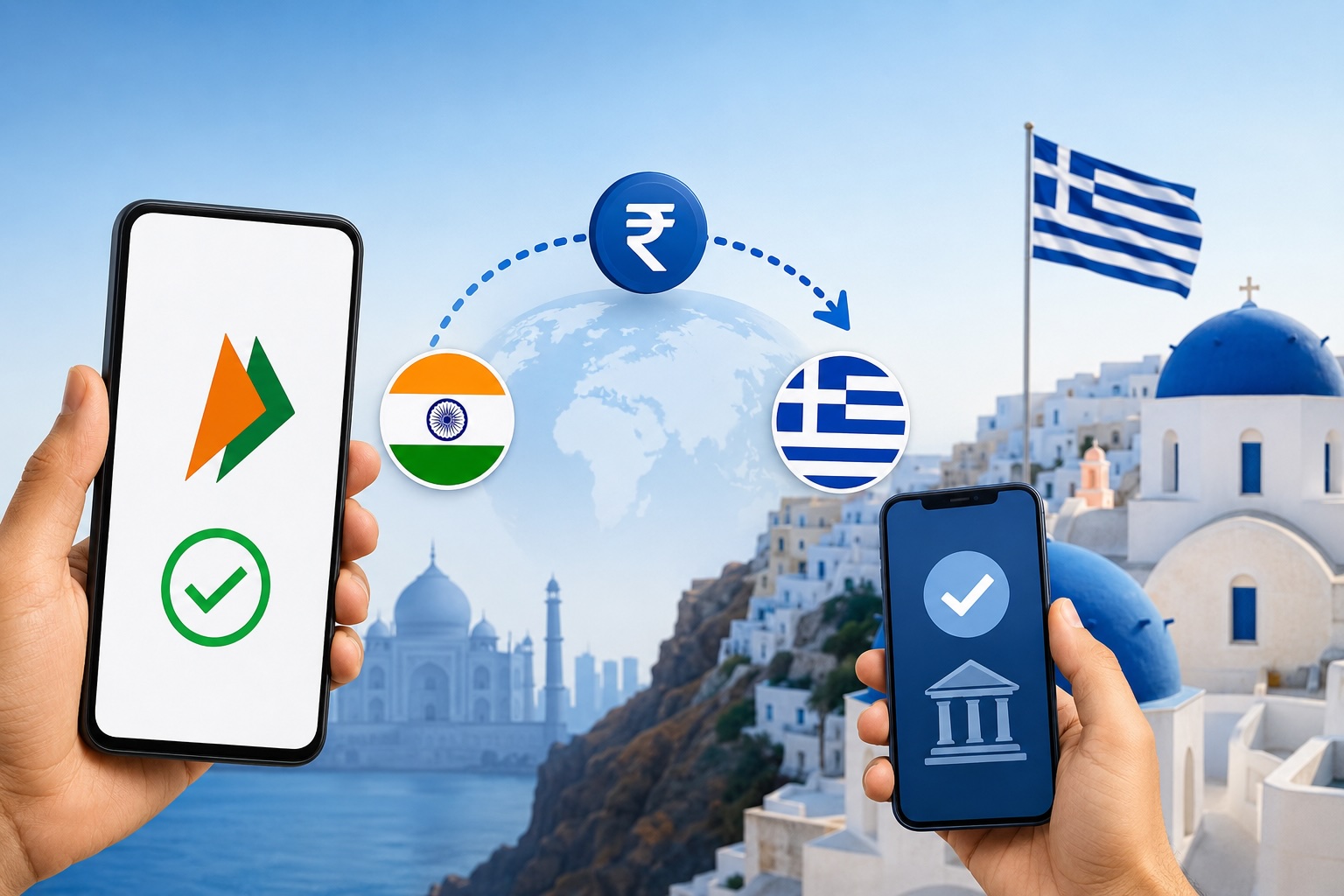
India’s most popular digital payment system, Unified Payments Interface (UPI), has expanded to Greece, giving users a faster and easier way to send money across borders.
The move is another step in India’s effort to take its homegrown payments technology to roughly 10 countries now.
According to the federal government, UPI is already live in eight countries, including the UAE, Singapore, Bhutan, Nepal, Sri Lanka, France, Mauritius and Qatar, positioning India as a global leader in digital payments. Its growing international adoption is boosting remittances, promoting financial inclusion, and strengthening India’s position in the global fintech landscape.
“With UPI now live in Greece, eligible customers can transfer money instantly, securely, and seamlessly, with transaction costs reducing drastically to a fraction of conventional transfer costs,” informed Piyush Goyal, India’s Minister of Commerce and Industry.
Since its launch in 2016, UPI has grown from a domestic payment system into a global benchmark for real-time transactions, with billions of payments processed each month across India alone. The government says the next phase of growth will focus on deepening adoption, improving interoperability and expanding the use of advanced technologies such as AI across financial services.
“The increasing global acceptance and appreciation of UPI reflects the trust in PM @NarendraModi ji’s vision of building technology-led solutions that create value beyond borders and deepen partnerships for shared growth and prosperity,” Goyal added.
UPI’s expansion into Greece has been enabled through a collaboration between Eurobank and NPCI International Payments Limited (NIPL), helping bring India’s digital payments infrastructure to a wider global audience. For customers, this means eligible users can transfer money almost instantly, with secure transactions and far lower fees than traditional remittance or bank transfer services. Payments that once involved higher charges and longer waiting times can now be completed more smoothly and at a fraction of the cost.
Launched in April 2016 by the National Payments Corporation of India (NPCI) under the oversight of the Reserve Bank of India (RBI), UPI has evolved from a domestic innovation into a global benchmark for instant, secure, and inclusive payments. With billions of transactions processed every month, the next phase of growth is expected to bring even more users and businesses into India’s rapidly expanding digital payments ecosystem.
From tea stalls to tech: India runs on UPI
As the Digital India programme marks its 11th anniversary on July 1, the milestone highlights how digital tools and payment systems are reshaping daily life across the country. From paying grocery bills to transferring money within seconds, UPI has transformed how millions of people handle money, making transactions faster, easier, and more accessible.
Over the past year alone, UPI handled nearly 24,000 crore (about 240 billion) transactions, and has earned recognition from the International Monetary Fund as the world’s largest real-time payment network. The growth has been extraordinary: according to the federal government, annual UPI transactions surged to more than 24,162 crore (about 241.62 billion) in FY2025–26 — an increase of nearly 12,000 times in a decade. The total value of payments also surged dramatically, rising from ₹0.07 lakh crore (about US$745 million) to around ₹314 lakh crore (roughly US$3.34 trillion) during the same period, showing how deeply digital payments are now woven into everyday financial activity.
According to government data, more than 700 banks have been integrated into the UPI ecosystem, which now accounts for nearly 49% of global real-time payments. This widespread adoption has boosted high-volume retail transactions and supported broader financial inclusion through digital channels.
For consumers, UPI has changed how money moves. Payments that once required cash, card swipes, or lengthy bank transfers can now be completed instantly, securely, and often at no extra cost. Its ease of use has helped millions of people, including small merchants and first-time digital users, join the formal financial system.
Ten years after its launch, India’s UPI has become an essential part of daily life, powering everything from small tea-stall purchases to large retail payments with just a few taps on a smartphone. What started as a new way to transfer money has grown into the world’s largest real-time payments platform, playing a central role in boosting India’s digital economy.