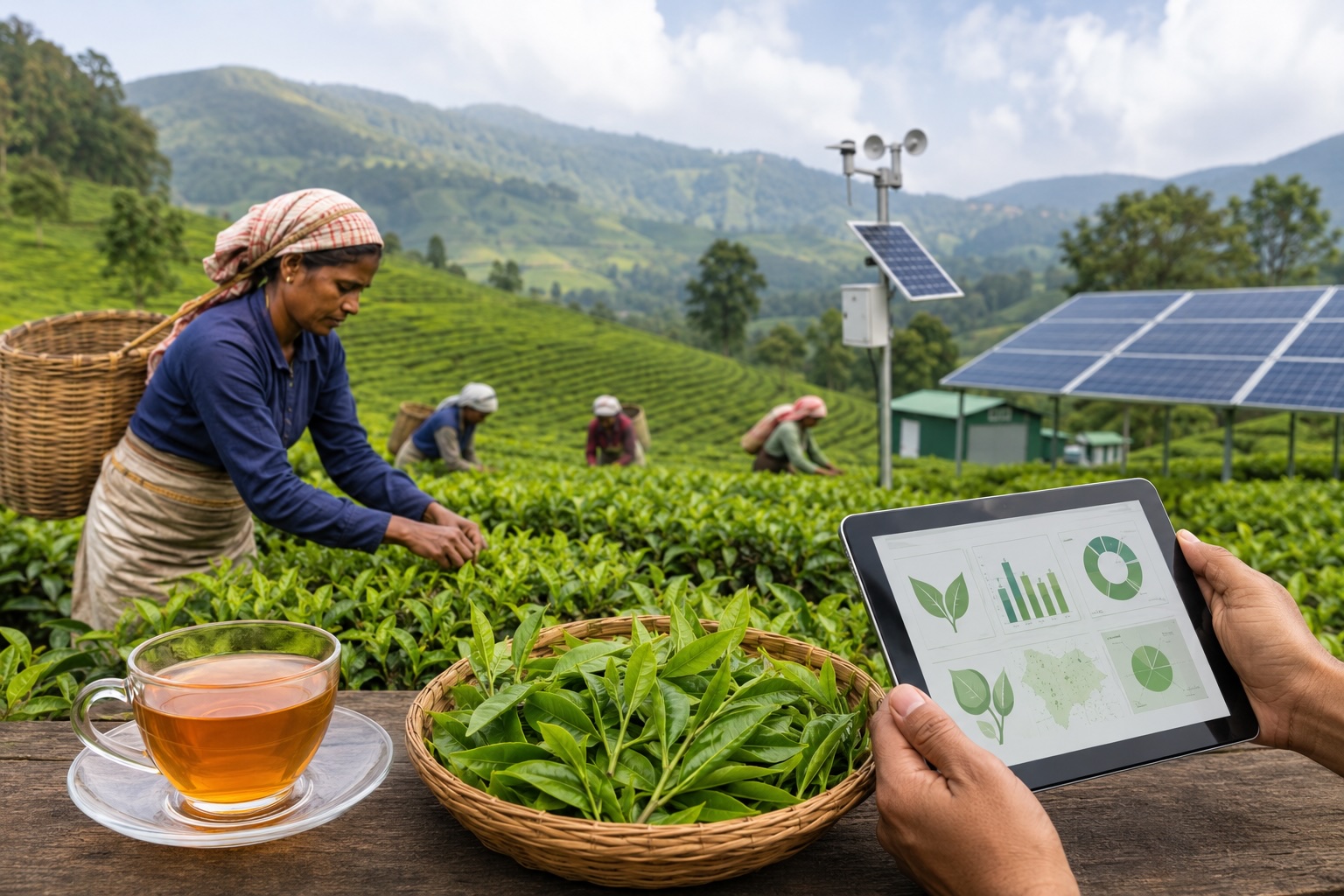
India’s tea sector, a 200-year-old industry woven into the country’s agricultural and cultural fabric, is embracing modern technologies and sustainability measures to secure its future. From traceability systems and mechanisation to digital marketing and climate-smart farming, the industry is entering a new phase aimed at strengthening productivity, quality and global competitiveness.
As the world’s largest producer and consumer of black tea, India sees adaptation as the cornerstone of long-term growth. Industry stakeholders increasingly recognise that climate resilience, better organisation of small growers, stronger branding and quality preservation will determine how successfully the sector navigates future challenges.
India produced nearly 1,370 million kilograms of tea in 2025, reinforcing its position as the world’s second-largest tea producer after China. Despite market volatility and production shocks, the sector continues to demonstrate resilience.
Official data released in May 2026 shows India’s tea production has remained relatively stable over the past decade, even as growers grappled with weather disruptions, pest attacks, ageing plantations and labour shortages. National production stood at roughly 1,267 million kilograms in 2016, rising steadily to about 1,390 million kilograms in 2019 before dropping to almost 1,257 million kilograms in 2020, largely due to pandemic-related disruptions.
Production recovered to about 1,393 million kilograms in 2023, declined to roughly 1,303 million kilograms in 2024, and rose again to about 1,370 million kilograms in 2025. The trend reflects an industry capable of recovery but still highly vulnerable to climatic and structural pressures.
Why this matters
Tea remains deeply embedded in Indian consumption patterns, with millions relying on it as a daily staple. Beyond domestic demand, tea is a major export commodity and a valuable source of foreign exchange.
Its economic significance extends far beyond trade: tea cultivation supports livelihoods across rural and remote regions, sustaining plantation workers, small growers, transport networks, local businesses and allied services.
Unlike seasonal crops, tea is a perennial plantation crop, which means that environmental stress accumulates over years. This makes climate change one of the most pressing threats facing the sector.
Industry studies indicate that erratic rainfall, prolonged droughts, flooding, rising temperatures and shifting humidity patterns are already affecting yields and quality. These disruptions increase pest and disease pressure as well as raise production costs and reduce farm profitability.
The north-eastern state of Assam, which produces over half of India’s tea, saw output fall in 2024 amid prolonged heatwaves, erratic monsoon rainfall, and flooding during peak harvest season. Tea industry reports noted Assam production dropped to about 650 million kilograms in 2024, down from about 688 million kilograms in 2023.
Sustainability strategies
For tea growers, climate adaptation is no longer optional. It has become an immediate operational necessity.
Sustainability strategies now focus on a combination of replanting ageing bushes, improving soil health, enhancing water-use efficiency and integrating renewable energy into plantation operations. Organic and low-input cultivation models are also gaining attention where feasible.
Certification for sustainably produced tea is increasingly important in export markets, where consumers and buyers demand stronger environmental accountability. For large plantations, uprooting and replanting ageing tea bushes remains essential for sustaining yield and quality over the long term.
The sustainability challenge also varies by geography. Tea-growing regions in India’s North Eastern states, parts of West Bengal, the Nilgiri Hills and the Himalayan foothills depend on ecologically fragile landscapes. Many of these areas face difficult terrain, poor transport infrastructure and higher logistics costs, making production more expensive and climate shocks more damaging.
Protecting these landscapes requires a dual approach: safeguarding ecological balance while improving infrastructure and market access. Better roads, storage facilities, energy access and supply-chain integration can help growers remain competitive without degrading the ecosystems that sustain tea cultivation.
Digital transformation for growth
Digital transformation is also emerging as a critical growth driver. Traceability systems can improve transparency from plantation to cup, enabling buyers to verify origin, sustainability standards and quality.
Earlier in 2026, Tea Board India expanded digital traceability initiatives aimed at improving transparency and quality assurance across supply chains.
At the same time, mechanisation is beginning to help address labour shortages in selected operations, while digital marketing is allowing Indian tea brands to reach global consumers more directly and build premium market positioning.
As global demand grows for ethically sourced tea, Indian producers are adopting traceability tools, mechanisation and climate-resilient farming. How well the sector balances productivity, quality and climate resilience will shape its long-term competitiveness.