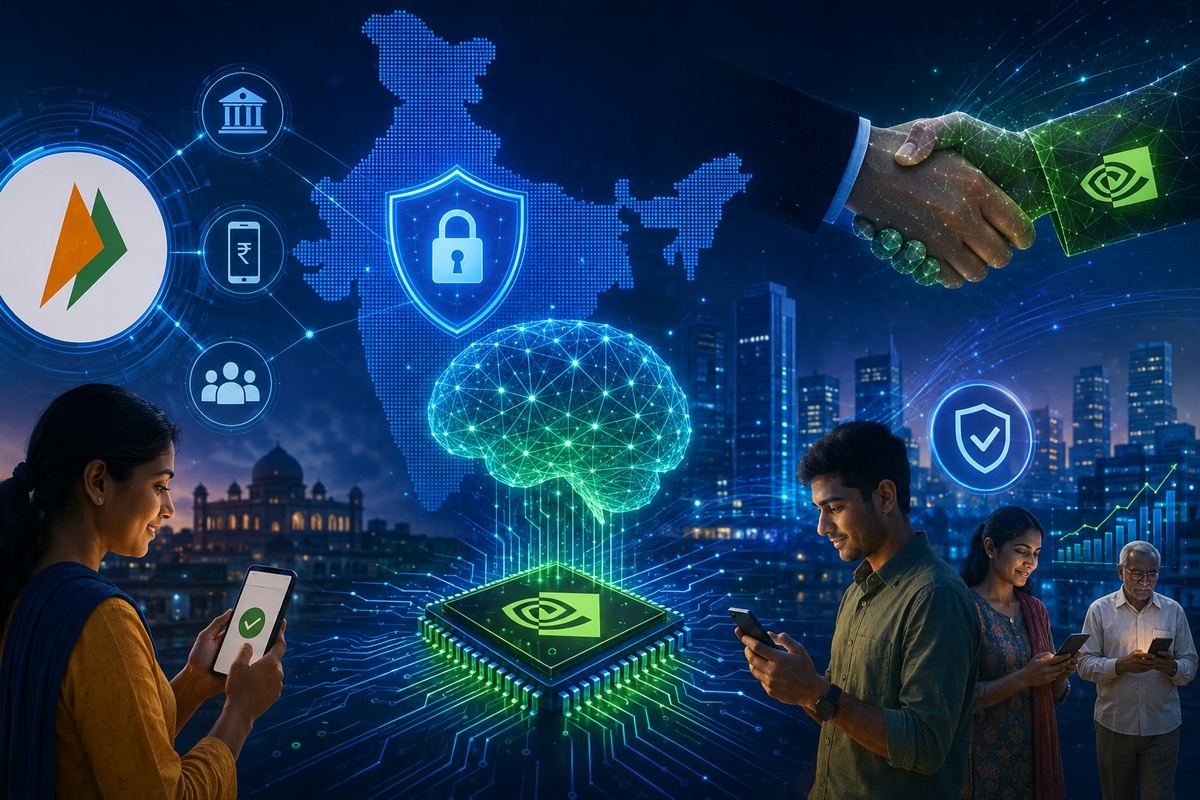
India has taken a major step in strengthening its digital payments infrastructure, with the National Payments Corporation of India (NPCI) partnering California-headquartered NVIDIA to develop advanced artificial intelligence (AI) tools tailored for the country’s payments ecosystem.
NPCI is the central body responsible for overseeing retail payments and settlement systems in India. The collaboration aims to help NPCI build sovereign AI systems designed specifically for India’s large-scale real-time payment networks. The focus is on improving reliability, security, and operational efficiency while ensuring that sensitive financial data remains within India’s regulatory and data governance framework.
“India has one of the most advanced digital payment systems in the world that operates at population scale where trust, resilience, and performance are fundamental,” Vishal Dhupar, Managing Director, Asia South, NVIDIA, said in a statement. “With accelerated computing and AI, we aim to strengthen India’s fintech infrastructure while enabling responsible innovation across the ecosystem.”
By combining NPCI’s expertise in managing payment systems used by millions of people with NVIDIA’s AI computing capabilities, the initiative seeks to create AI models built for the unique demands of digital payments. As part of this effort, NPCI plans to use NVIDIA’s Nemotron family of open AI models to develop a payments-focused AI foundation model that aligns with India’s data sovereignty requirements.
NPCI said it has already started using AI to solve practical challenges in digital payments. One recent example is the UPI Help Assistant, a pilot tool designed to improve customer grievance resolution. Powered by a specialised language model built for India’s financial ecosystem, the assistant helps users get faster and more consistent support for payment-related issues.
For consumers, the integration of artificial intelligence into India’s payments infrastructure is expected to make everyday transactions faster, safer and more seamless. In practical terms, this could mean quicker resolution of failed or disputed Unified Payments Interface (UPI) payments, fewer transaction errors, and improved fraud detection that reduces the risk of financial scams. AI-driven systems may also enable more responsive customer support — potentially in multiple languages — helping users in smaller towns and first-time digital payment users navigate issues more easily.
Over time, as these tools become embedded across banks and payment apps, users could experience smoother digital transactions with less downtime, more personalised assistance, and greater confidence in using cashless payment systems for routine activities, from buying groceries to paying bills.
System-wide AI for payments network
NPCI has been instrumental in introducing a range of products that have revolutionised retail payment systems, including the most popular Unified Payments Interface (UPI). Over the past year alone, UPI handled nearly 24,000 crore (240 billion) transactions, and has earned recognition from the International Monetary Fund as the world’s largest real-time payment network.
Looking ahead, NPCI said it intends to move beyond single-purpose AI tools and build a broader AI layer that can support the entire payments ecosystem. This next phase may include advanced AI architectures capable of handling high transaction volumes with minimal delays, while also improving multilingual support and automation.
In the long run, the initiative could benefit banks, fintech companies, and payment service providers by enabling smarter fraud prevention, faster issue resolution, stronger trust mechanisms, and better operational insights. Throughout the process, NPCI said data security, responsible AI use, and digital sovereignty will remain central priorities.
“Through this collaboration with NVIDIA, NPCI aims to advance AI capabilities designed specifically for India’s payments ecosystem. Drawing from our experience of operating population-scale, real-time payment systems, this initiative is designed to create a sovereign, payments-native AI foundation that strengthens trust, resilience, and security, while remaining aligned with India’s regulatory and data sovereignty requirements,” said Vishal Kanvaty, Chief Technology Officer of NPCI.
“As we evolve from use-case–led AI deployments to a foundational and scalable AI layer, our focus remains on enabling the broader ecosystem to innovate responsibly through robust governance frameworks and secure, future-ready infrastructure,” Kanvaty added.
The partnership between NPCI and NVIDIA marks a significant step toward embedding artificial intelligence at the core of India’s digital payments ecosystem. By combining large-scale payments expertise with advanced AI capabilities, the initiative aims to build a more secure, efficient, and resilient infrastructure designed for real-time transactions at population scale. As India continues to expand its digital economy, this collaboration could play a key role in shaping a future where payments are not only faster and more seamless, but also more intelligent, adaptive, and firmly rooted in data sovereignty and trust.