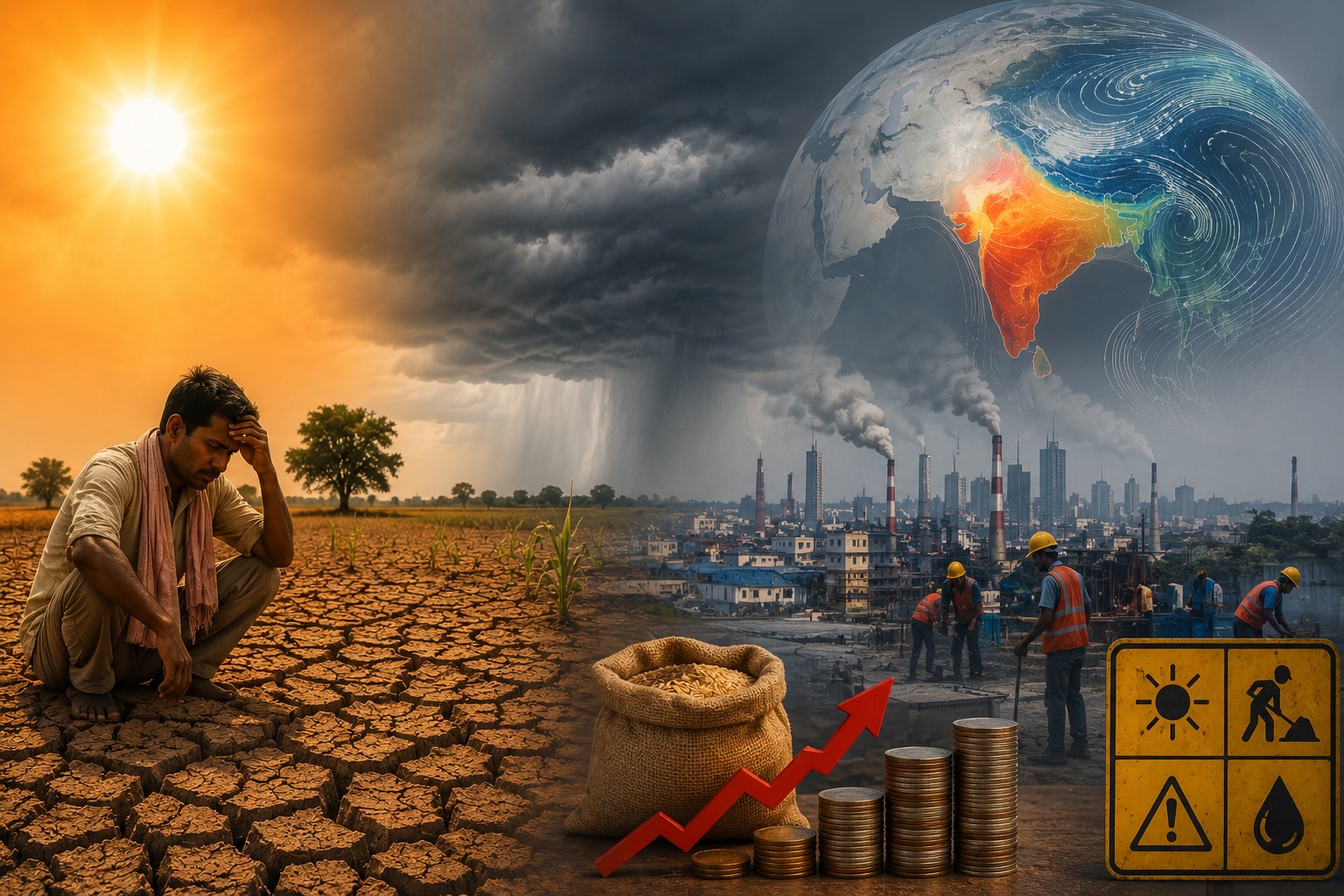
India is confronting an increasingly volatile climate system as delayed monsoon rains, intensifying heatwaves, and emerging scientific evidence of long-term atmospheric shifts raise fresh concerns about food security, labor safety, and economic stability. Over the past two weeks, a series of climate-linked developments across the world’s most populous nation has underscored a troubling pattern: extreme weather is no longer appearing as isolated events but as interconnected symptoms of a rapidly warming planet.
The southwest monsoon, often described as the backbone of India’s agricultural economy, has recorded one of its weakest starts in more than a decade. The delayed onset of seasonal rains comes amid strengthening El Niño conditions in the Pacific, a climate phenomenon historically associated with suppressed rainfall over the Indian subcontinent.
While India’s irrigation infrastructure has improved significantly over recent decades, climate scientists warn that the country’s agricultural resilience is being tested by a combination of delayed rainfall and extreme heat.
The implications are significant. Nearly half of India’s workforce remains dependent on agriculture either directly or indirectly, and millions of smallholder farmers rely on timely monsoon rainfall for sowing key crops such as rice, soybean, cotton, and pulses. When rains arrive late, sowing windows shrink, crop cycles become compressed, and the risk of yield losses rises sharply.
A weaker monsoon also threatens food prices. Vegetables, cereals, and pulses are particularly sensitive to rainfall variability, and lower agricultural output could push inflation higher in the coming months. Food inflation remains a politically sensitive issue in India, especially for lower-income households that spend a disproportionate share of earnings on essential commodities.
When monsoon falters, livelihoods hang in balance
The risks extend beyond agriculture. Poor rainfall can weaken reservoir storage and reduce groundwater recharge, intensifying water stress in already vulnerable regions. This is particularly concerning for semi-arid areas where groundwater extraction already exceeds sustainable levels.
Central India offers a stark example of this growing climate stress. In Vidarbha, eastern Maharashtra, delayed monsoon rains have coincided with renewed heatwave warnings, with temperatures crossing 42 degrees Celsius in several districts. Farmers in the region were advised to postpone sowing decisions as uncertainty over rainfall persists. For many, this creates a difficult gamble: sow too early and seeds may fail in dry soil; wait too long and the crop season becomes too short to ensure viable yields.
The economic consequences of such delays can be severe. Soybean and cotton farmers, who dominate cultivation in Vidarbha, often operate with thin financial margins and high input costs. Failed sowing or reduced yields can trigger debt stress, deepen rural vulnerability, and increase dependence on credit. At the same time, water shortages encourage greater groundwater pumping, accelerating depletion of already stressed aquifers.
Factory floors become new frontline of climate change
Yet the climate crisis in India is no longer confined to farms and rural landscapes. Heat is increasingly reshaping urban labor conditions as well.
A recent report from Surat, one of India’s largest textile manufacturing hubs, illustrates how rising temperatures are creating dangerous working environments inside factories. In poorly ventilated industrial units, indoor heat levels are reaching hazardous thresholds, exposing workers to dehydration, exhaustion, and heat-related illness.
For many laborers, the threat is unavoidable. Textile workers often spend long shifts near heat-generating machinery in enclosed spaces where airflow is minimal. As outside temperatures climb, indoor conditions become even more punishing. Heat stress reduces concentration, slows productivity, increases fatigue, and elevates accident risk.
This represents a profound shift in how climate change affects India’s economy. Traditionally framed as an environmental or ecological issue, climate change is now directly influencing workplace safety, labor productivity, and industrial output.
Experts increasingly argue that India requires mandatory heat safety standards for both outdoor and indoor workers. Such measures could include regulated break schedules, hydration requirements, improved ventilation, and temperature-based work restrictions during extreme heat events. Without systemic protections, millions of workers in manufacturing, construction, logistics, and agriculture may face escalating health risks.
The economic costs of heat exposure are also mounting. Reduced worker productivity translates into lower industrial efficiency and higher healthcare burdens. In sectors dependent on manual labor, climate stress may gradually erode competitiveness and increase social inequality, as the poorest workers often have the least protection.
Global ocean changes may be reshaping India’s monsoon
Beyond immediate weather impacts, emerging scientific research suggests the South Asian powerhouse may be facing something even more consequential: structural shifts in monsoon behavior itself.
New climate studies examining the North Atlantic “cold blob” — an unusual region of cooler ocean water amid broader global warming — indicate that distant ocean changes may be influencing South Asian rainfall patterns. Researchers suggest these Atlantic anomalies may alter atmospheric circulation in ways that reshape the Indian summer monsoon.
The findings point toward a troubling possibility. Rainfall could increase over parts of northwestern India while declining across sections of the Indo-Gangetic plain, one of the most densely populated and agriculturally critical regions in the world.
Such a redistribution of rainfall would carry enormous implications. The Indo-Gangetic plain supports extensive production of wheat, rice, and other staple crops while sustaining hundreds of millions of people. Even moderate long-term declines in rainfall could disrupt food systems, strain water resources, and trigger migration pressures.
This research reinforces a critical scientific conclusion: India may not simply be experiencing a string of bad monsoon years. Instead, the monsoon system itself could be entering a new climate regime shaped by global ocean warming, altered atmospheric circulation, and compounding feedback loops.
That possibility challenges long-standing assumptions about climate adaptation. Historically, planners have relied on past rainfall patterns to guide agricultural calendars, reservoir management, and infrastructure design. But if monsoon behavior is fundamentally shifting, historical averages may no longer provide reliable guidance.
This creates a major policy challenge. Climate adaptation can no longer focus solely on responding to extreme events after they occur. Instead, India may need to redesign systems proactively — rethinking crop choices, water governance, urban planning, labor protections, and early warning mechanisms.
Cascading climate impacts testing India’s resilience
The convergence of delayed rainfall, extreme heat, and shifting climate patterns reveals an important truth: climate risks are interconnected. A weak monsoon does not only affect crops; it can raise food prices, deepen water shortages, strain household finances, and intensify social vulnerability. Heatwaves do not only threaten health; they also disrupt labor productivity and economic output.
These cascading effects highlight why climate change is increasingly viewed as a systemic economic risk rather than merely an environmental concern.
India remains among the countries most exposed to climate volatility due to its dependence on monsoon rainfall, large agricultural workforce, and rapidly urbanizing population. At the same time, it is also a country with significant adaptive potential, driven by growing renewable energy investments, expanding climate policy, and improving disaster response systems.
The question is no longer whether climate change is reshaping India — it already is. The more urgent question is whether institutions can adapt fast enough to reduce vulnerability before climate shocks become even more disruptive.
This year’s delayed monsoon and punishing heatwaves serve as a warning. Climate change in India is not a distant future scenario. It is unfolding now — in parched fields, overheated factories, strained reservoirs, and unstable weather systems.
What was once considered exceptional is becoming increasingly normal. And that may be the most alarming signal of all.