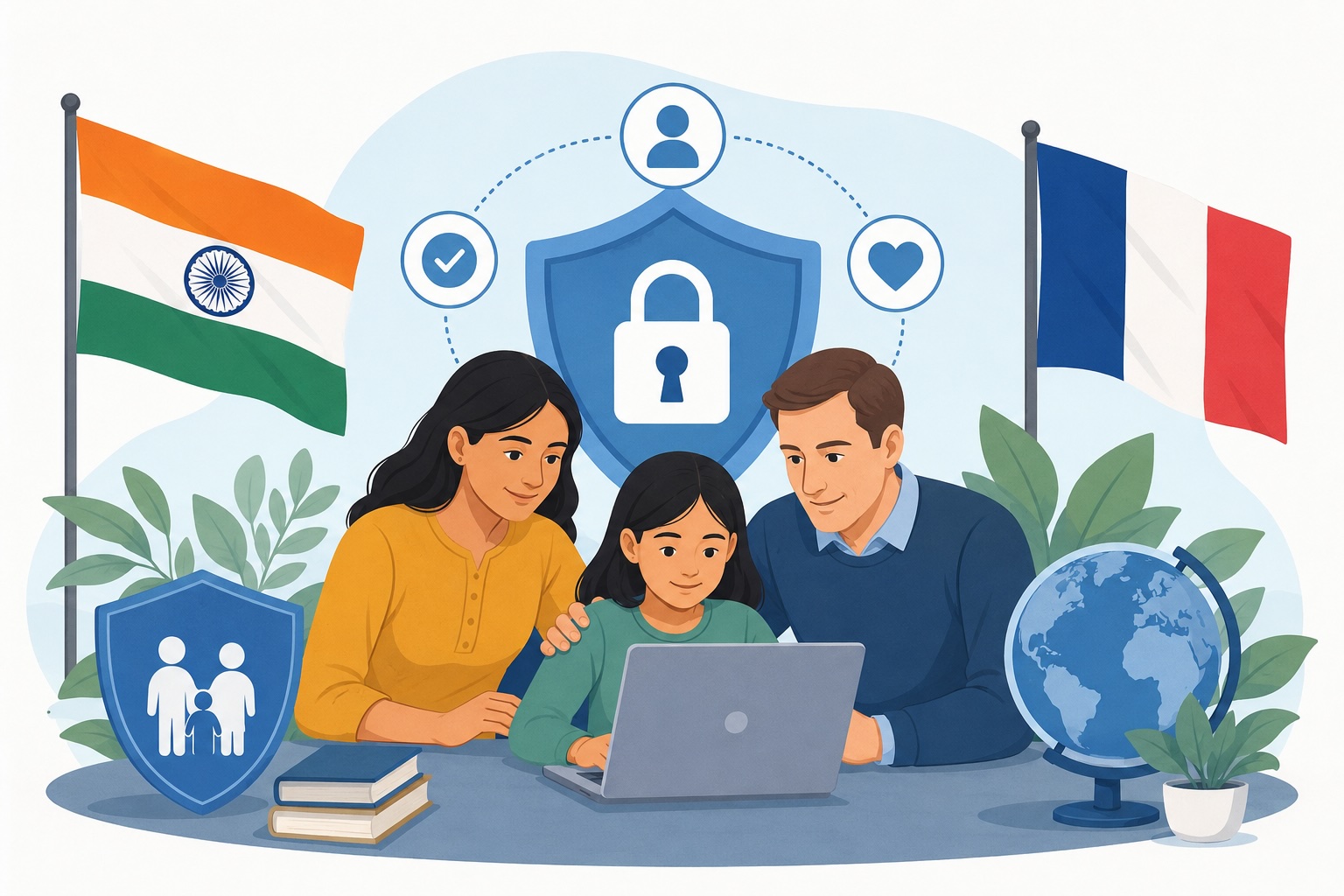
As governments race to make the digital world safer for the next generation, a fundamental question is taking centre stage: how can children be protected online without cutting them off from the opportunities technology offers? Against this backdrop, India and France have placed child safety at the heart of their expanding AI partnership, even as countries such as the U.K. move toward stricter limits on young consumers’ access to social media. The debate reflects a growing global effort to balance innovation, protection and digital freedom in an age where being online is no longer an activity—it is a way of life.
For parents worried about what their children encounter online, India and France’s latest innovation partnership could bring greater safeguards to the digital services young people use every day. Under the India-France Innovation Roadmap 2030, the two countries are expanding cooperation in emerging technologies, with online child safety standing out as a key area of focus.
“The partnership between India and France will continue to reach new heights,” Indian Prime Minister Narendra Modi said on X.
Building on discussions held at the AI Impact Summit 2026 and India’s evolving regulatory approach to online child protection, the India-France partnership aims to translate policy discussions into practical measures that can help create a safer digital experience for children and families.
As artificial intelligence (AI) becomes increasingly embedded in social media, gaming, education and other digital platforms, both governments have acknowledged the growing risks these technologies can pose to children. To address these concerns, India and France have announced their plan to work together on developing stronger online protections, including age-verification systems that respect user privacy, safer platform designs that prioritize child wellbeing from the outset, and clearer safety standards for AI-powered services that interact with children.
“Recognizing the acute risks that AI-enabled services pose to vulnerable sections particularly children in the digital environment, India and France agree to deepen their cooperation on child safety online as a priority of their AI partnership,” the official statement said.
“Building on the Expert Engagement Group on AI and Child Safety convened at the AI Impact Summit 2026 and India’s emerging techno-legal framework on child safety online, the two sides [India and France] will develop concrete synergies between their ongoing initiatives, including privacy-preserving age assurance, safety-by-design architectures, and outcome-based safety standards for AI systems that materially interact with children,” it informed.
Race to protect children online heating up
The privacy and surveillance push by India and France to strengthen online protections for children comes at a time when governments around the world are reassessing the impact of social media on young users. In the United Kingdom, Prime Minister Keir Starmer has proposed a ban that would prevent children under 16 from accessing social media platforms, arguing that many of these services contribute to excessive screen time, expose children to bullying, and are intentionally designed to keep users engaged for longer periods.
If the proposal receives parliamentary approval, it could take effect in 2027 and apply to major social networking platforms, while also restricting features such as livestreaming for minors, including on certain gaming services. The move reflects growing concerns among policymakers and parents about the influence digital platforms have on children’s wellbeing and development.
“Parents want to keep their kids safe and happy, but the online world has made that harder than ever. I’ve heard first hand from families crying out for change and we will do right by them,” Starmer said in the official statement.
“That’s why we’re going further than any country in the world by banning social media for under-16s and putting wider protections in place to give kids their childhood back. This is a line in the sand. Tech giants had their chance and failed, but we’re stepping in to protect children, back parents and set a new normal for future generations,” Starmer added.
Those concerns are unfolding against a backdrop of rising digital dependence among young adults. A recent Reuters Institute research found that for people aged 18 to 24, social media platforms have largely replaced publisher websites and news apps as the primary gateway to current events. Rather than actively visiting news outlets, many now encounter news while scrolling through their social feeds. The trend has also altered who young people trust and follow for information. On social and video platforms, many pay closer attention to independent creators, influencers and commentators than to established news organisations.
The research also revealed that video-driven platforms such as TikTok, Instagram and YouTube have become especially influential among younger audiences, reflecting a broader preference for short-form and visual content. This marks a significant change from a decade ago, when Facebook dominated the social news landscape.
The trend highlights the challenge governments face: keeping young users safe online while ensuring they can continue to benefit from the opportunities the digital world offers.
Your data, your choice
At its core, the India-France Innovation Roadmap 2030 is designed to ensure that advances in technology benefit people while protecting their rights and freedom. The two countries say their collaboration will be built on shared democratic principles, trust, openness and a commitment to developing technology that serves society rather than the other way around.
One major area of focus is data privacy. As artificial intelligence increasingly relies on large volumes of data, India and France plan to explore ways of enabling secure data sharing without compromising individual privacy. By combining India’s consent-driven data-sharing framework with France’s experience in trusted data ecosystems, the partnership aims to support innovations in sectors such as healthcare, scientific research and public services while giving users greater control over how their information is used.
“India and France recognize the centrality of privacy-preserving data sharing frameworks to unlock the full potential of AI and data-driven innovation while safeguarding fundamental rights. India’s Data Empowerment and Protection Architecture (DEPA) and France’s own work on trusted data spaces and health data platforms offer complementary strengths that can support secure, consent-based data flows for research, healthcare, and public services,” the statement informed.
The two countries have also committed to promoting AI systems that are safe, transparent and accountable. Their goal is to encourage the development of technologies that respect human rights, reduce the risk of bias and discrimination, and help limit the spread of misleading or harmful content online. To achieve this, India and France plan to strengthen cooperation among policymakers, regulators and technical experts, working toward common standards for governing advanced AI systems while ensuring that innovation continues to flourish and contribute to economic and social progress.
Smarter healthcare, stronger privacy
India and France are also expanding their collaboration in healthcare, with a focus on using artificial intelligence and research-driven technologies to tackle pressing public health challenges. A key element of this effort is ensuring that any sharing of health data happens with the informed consent of individuals and within the legal safeguards established by each country.
Building on existing projects between Indian and French health research institutions, the partnership aims to develop secure systems that allow data to be used for medical research and innovation while protecting personal privacy. If successful, these frameworks could be adapted for use in other sectors and potentially serve as a model for countries across the Global South seeking to balance innovation with data protection.
“Building on ongoing collaborations such as the pilot project involving India’s ICMR and France’s Health Data Hub (HDH), the two countries will work on consent-based architectures, in compliance with national legal frameworks, for secure data sharing that can be scaled, adapted to additional sectors and shared with interested partners, including in the Global South,” the official statement informed.
To support these goals, India and France plan to bring together regulators, technical experts and organizations involved in managing data ecosystems. Their objective is to create compatible and privacy-conscious digital infrastructures that make it easier to share information responsibly, accelerate AI-powered research, and deliver better outcomes for citizens.