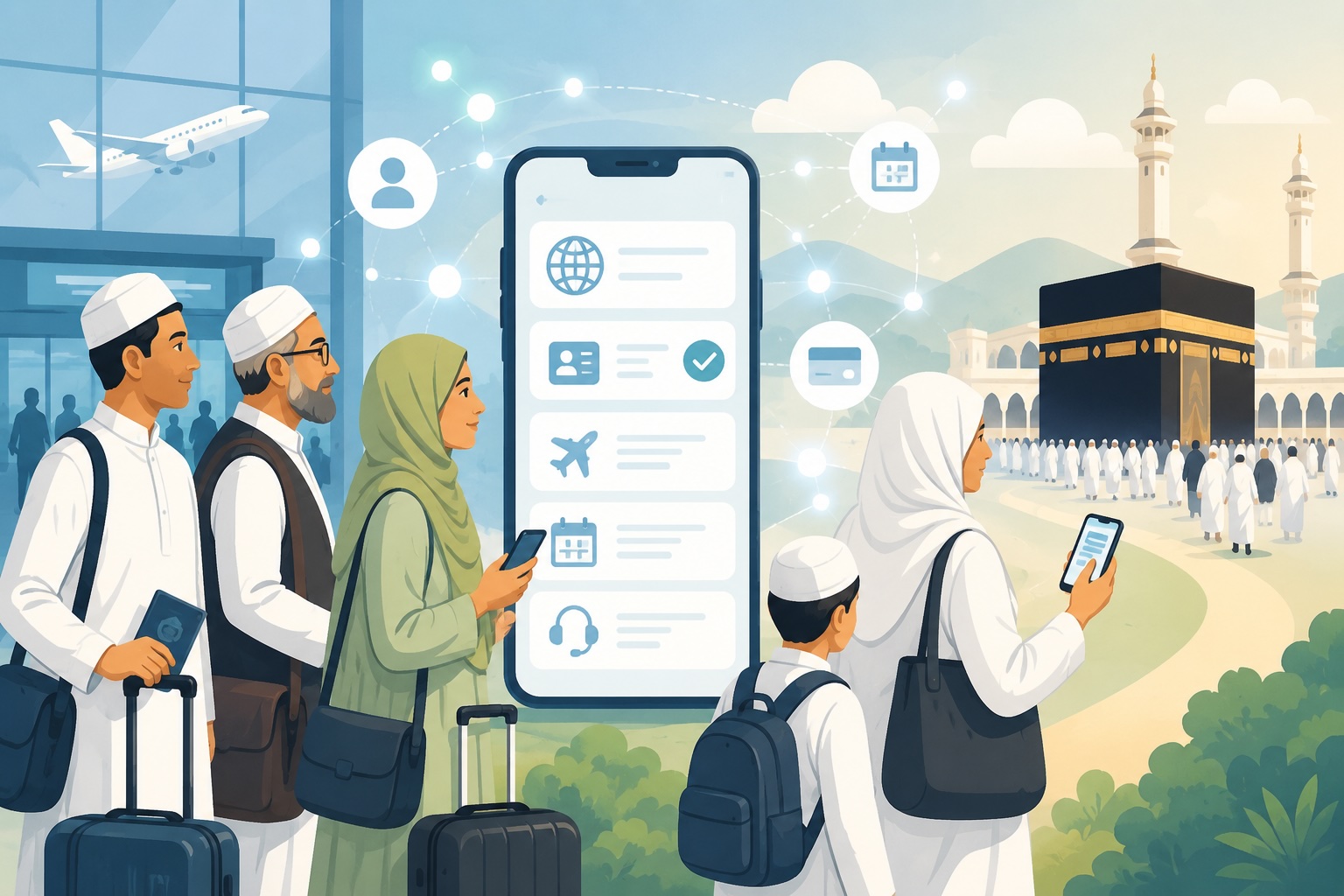
Planning to perform Haj from India in 2026? The government has expanded its digital services to make the pilgrimage easier, allowing pilgrims to apply online, make payments, choose preferred flight timings, access travel information, and seek help through a single mobile app.
The world’s most populous nation has introduced a range of new digital services aimed at making the Haj pilgrimage smoother and more convenient for people travelling to Saudi Arabia in 2026.
Haj is one of the five pillars of Islam and is a mandatory religious pilgrimage for every Muslim who is physically and financially able to undertake it at least once in their lifetime. The pilgrimage takes place every year in the Islamic month of Dhu al-Hijjah in and around the holy city of Mecca in Saudi Arabia, drawing millions of worshippers from across the world.
According to India’s Ministry of Minority Affairs, the nodal Ministry for Haj, the new digital initiatives are designed to simplify every stage of the journey, from application and travel planning to on-ground assistance and grievance redressal.
“The government is committed to ensure the safety, welfare, comfort and overall well-being of Indian Haj pilgrims through digital services and reforms…The government has [also] taken several measures to enhance the welfare of Indian Haj pilgrims during Haj 2026, particularly in the areas of healthcare, accommodation, transportation and emergency assistance,” Union Minister of Minority Affairs, Kiren Rijiju, informed in a written reply in Rajya Sabha, the upper house of India’s bicameral Parliament.
The expansion of digital services marks a broader effort by the Indian government to modernize the administration of one of the country’s largest overseas pilgrimages. By moving key processes such as applications, payments, passport verification, travel updates, and grievance redressal online, the government aims to reduce paperwork, improve transparency, speed up service delivery, and make the pilgrimage more accessible.
The digital platform also enables authorities to communicate quickly with pilgrims, provide real-time travel and safety information, and respond more efficiently to emergencies or complaints, helping improve the overall experience for thousands of Indian pilgrims travelling to Saudi Arabia each year.
Beyond improving services for pilgrims, the initiative also reflects the growing cooperation between India and Saudi Arabia on the annual Haj pilgrimage. Every year, the two governments coordinate closely on issues such as pilgrim quotas, flights, accommodation, health protocols, and logistical arrangements for one of the world’s largest religious gatherings. By adopting more efficient digital systems, India can share accurate passenger and travel information with Saudi authorities, streamline coordination, and better manage the movement of tens of thousands of pilgrims. The reforms also underscore India’s efforts to strengthen consular support for its citizens abroad while reinforcing its broader partnership with Saudi Arabia.
India’s Ministry of Minority Affairs said that the Haj 2026 pilgrims will receive insurance coverage of up to ₹6.25 lakh (about US$6,500), offering financial protection in case of medical emergencies or other unforeseen situations during the pilgrimage. About 175,025 pilgrims are expected to undertake this pious pilgrimage of Haj in 2026, with the first batch of pilgrims scheduled to depart for the Kingdom of Saudi Arabia from various embarkation points across the country. Haj flights will operate from 17 embarkation points across India, including Delhi, Mumbai, Kolkata, Hyderabad, Bengaluru, Lucknow and Srinagar, allowing pilgrims from different regions to travel more conveniently.
From Maha Kumbh to Haj: India’s growing bet on technology for religious events
India is increasingly turning to digital technology to manage some of the world’s largest religious gatherings. After deploying AI-powered surveillance, digital services and blockchain-based initiatives during the 2025 Maha Kumbh Mela, the government is now introducing a suite of tech-driven tools for Haj 2026. The move reflects a broader effort to make pilgrimages safer, more efficient and easier to navigate for millions of devotees while improving the delivery of public services.
The goal is to simplify travel, reduce paperwork, strengthen safety, improve communication, and help authorities manage millions of visitors more efficiently. From online registrations and mobile apps to digital payments and real-time assistance, technology is increasingly becoming a key part of how religious events are organized.
In 2025, an estimated 660 million pilgrims attended the Hindu religious event of Maha Kumbh in Prayagraj, Uttar Pradesh, over six weeks. Authorities introduced artificial intelligence-powered cameras, drones, digital lost-and-found centres, and mobile services to improve crowd management and public safety. The event also featured blockchain-based digital collectibles, or non-fungible tokens (NFTs), issued in partnership with Indian Railways and technology companies. Pilgrims could receive digital souvenirs linked to their train journeys and tent bookings, while organizers described the initiative as an effort to blend tradition with emerging technology.
The digital transformation of both Maha Kumbh and Haj reflects a shift in how India is managing large-scale religious events. Rather than relying primarily on manual processes, authorities are increasingly using digital platforms to coordinate transport, accommodation, healthcare, emergency response, and public information. For pilgrims, these changes could mean shorter queues, easier access to services, faster assistance during emergencies, and better access to travel updates. For the government, digital tools also help improve coordination with multiple agencies, including international partners such as Saudi Arabia during the annual Haj pilgrimage.
India’s digital Haj: New tech aims at safety, convenience
For Indian pilgrims undertaking Haj 2026, a major upgrade is the Haj Suvidha App 2.0, designed as a single digital platform to support pilgrims throughout their journey. The app provides essential services such as flight schedules, accommodation details, baggage updates, emergency contacts, health advisories, and important travel notifications. It includes an SOS feature, as well as allows pilgrims to submit complaints and monitor the status of their resolution, helping them access assistance more quickly and conveniently.
The government has also continued its fully online application system, enabling prospective pilgrims to submit applications digitally. The selection process is conducted through a computerized system intended to ensure transparency.
Other digital services include secure online payment options for Haj-related expenses and an online facility that allows pilgrims to indicate their preferred flight dates and timings, subject to operational availability.
In another change aimed at reducing paperwork, applicants are no longer required to physically submit their passports, according to the Ministry of Minority Affairs. Passport details can now be uploaded digitally, reducing processing time and minimizing visits to state and union territory Haj Committee offices.
Pilgrims can also access accommodation details, flight information, and other travel-related updates through the Haj Suvidha App and the online Haj portal. The Ministry of Minority Affairs said the initiatives are intended to improve the safety, comfort, and overall experience of Indian pilgrims travelling for Haj.
The Ministry said it has made comprehensive arrangements in coordination with the Haj Committee of India, other central ministries, state governments, and Saudi authorities. These efforts are aimed at ensuring seamless logistics and improved on-ground facilitation for pilgrims.
From online applications to smart wristbands
One of the biggest additions for Indian Muslims travelling for Haj in 2026 is the ‘Haj Suvidha Smart Wristband’, which can help authorities identify pilgrims, locate those who go missing and provide quicker assistance during emergencies. The government has also introduced a short-duration Haj package of about 20 days for the first time, giving eligible pilgrims a faster travel option.
Travel within Saudi Arabia is also expected to become more convenient. Around 60,000 Indian pilgrims will be able to use the high-speed rail service between Makkah and Madinah, cutting travel time while improving comfort and safety.
The government said it has strengthened its support systems by improving real-time monitoring, expanding grievance redressal services, enhancing medical screening before departure, and improving coordination for accommodation and transport in Saudi Arabia. For the first time, hotel-style accommodation has been arranged in Makkah for pilgrims travelling through the government quota.
Healthcare support has also been expanded. India will deploy doctors, nurses and other medical personnel to Saudi Arabia, while clinics and medical centres will operate at key pilgrimage sites to provide treatment throughout the Haj season.
To make departures smoother, the Ministry said that authorities have streamlined airport procedures. Special arrangements have also been made for elderly pilgrims. Those aged 65 years and above must travel with a companion to ensure they receive assistance throughout the pilgrimage.
According to the Ministry of Minority Affairs, these measures have been implemented in close coordination with Saudi authorities to improve the safety, welfare and overall experience of Indian pilgrims during Haj 2026.