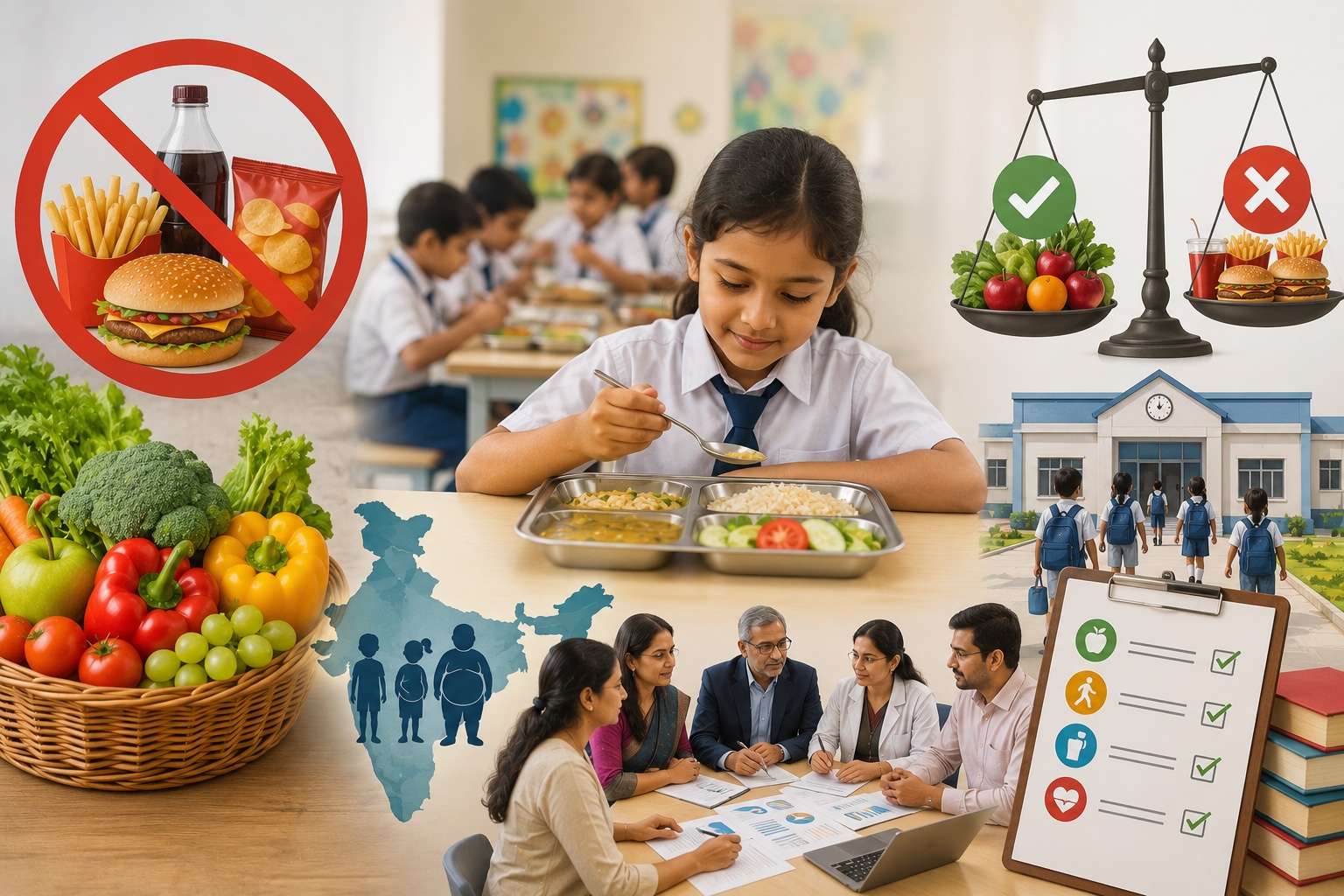
India’s leading nutrition researchers are urging stronger regulation of unhealthy foods and healthier school food environments as the country confronts a growing burden of childhood obesity and diet-related diseases.
The call comes in a new policy roadmap released by the Indian Council of Medical Research-National Institute of Nutrition (ICMR-NIN)-led “Let’s Fix Our Food” (LFOF) Consortium.
The document is based on nearly three years of research, consultations and policy discussions. It recommends a series of measures to help children and teenagers eat healthier and reduce their risk of diet-related diseases, India’s Ministry of Health and Family Welfare said in a statement.
The report calls for front-of-pack nutrition labels on food products, stricter rules on advertising unhealthy foods to children and taxes on foods that are high in fat, salt and sugar (HFSS). It also recommends healthier food in schools, lower salt intake, better nutrition education and stronger public awareness campaigns.
“Malnutrition is no longer only about undernutrition. Rising obesity, driven by unhealthy diets, challenges healthy growth among children and adolescents,” Marie-Claude Desilets, chief of nutrition at UNICEF India, said on the occasion. “The release of these ten policy briefs and the Nutrition Environment Assessment Toolkit for Schools (NEAT-S) marks a step towards creating policies for healthier school food environments. Every child has the right to grow up in a food environment that enables them to thrive, learn and achieve their full potential.”
These recommendations are important because the world’s most populous nation is facing a changing nutrition challenge. Undernutrition remains a problem in many parts of the country. At the same time, more children and teenagers are becoming overweight or obese. Health experts warn that unhealthy diets can increase the risk of diabetes, heart disease and other chronic illnesses later in life.
The policy document was introduced by NITI Aayog Member (Health) M. Srinivas during a consultation workshop in New Delhi. NITI Aayog is the main policy advice group and think tank of the Indian government.
“Evidence-based, multisectoral policy action is essential to create healthier food environments for children and adolescents,” Srinivas said.
“Collaborative initiatives such as the Let’s Fix Our Food Consortium are important for addressing the growing burden of overweight, obesity and diet-related non-communicable diseases in India,” Srinivas added.
The Let’s Fix Our Food Consortium brings together researchers, policymakers and public health experts to improve food environments in India, with a special focus on children and adolescents. Its latest policy recommendations are based on research from different fields and extensive consultations with stakeholders. The aim is to support coordinated, evidence-based action that can help prevent obesity and other diet-related non-communicable diseases. The policy briefs are available on the Let’s Fix Our Food website.
Evidence aims to shape next generation of food policies
The report does not introduce new government rules. Instead, it offers recommendations that could help shape future policies. Issues such as front-of-pack warning labels and restrictions on marketing unhealthy foods have been discussed in India for several years. The new report provides scientific evidence that could support future government action.
Along with the policy roadmap, the consortium launched several new tools to improve nutrition awareness. These include the Nutrition Environment Assessment Toolkit for Schools (NEAT-S), which helps schools assess whether their food environment encourages healthy eating. It also launched an e-learning course on reading food labels, educational resources on fats, sugar and salt, and a dedicated website.
These tools matter because they can help schools, teachers, parents and students make healthier food choices. They also support efforts to improve nutrition education from an early age.
The workshop also presented new research on school food environments, food marketing, eating habits, nutrition education and possible tax measures to encourage healthier diets. The findings are expected to help policymakers develop future nutrition policies based on evidence.
The Let’s Fix Our Food Consortium brings together government agencies, researchers and international organisations to support healthier food environments in India. Its latest recommendations aim to help policymakers create conditions that make healthy food choices easier for children and adolescents.
“ICMR-NIN is committed to generating high-quality evidence and fostering partnerships that translate research into public health action,” Bharati Kulkarni, director of ICMR-NIN, said in the statement.
“The policy recommendations reflect the collective efforts of researchers, policymakers, development partners and young people working towards healthier food environments for India’s future generations,” Kulkarni added.