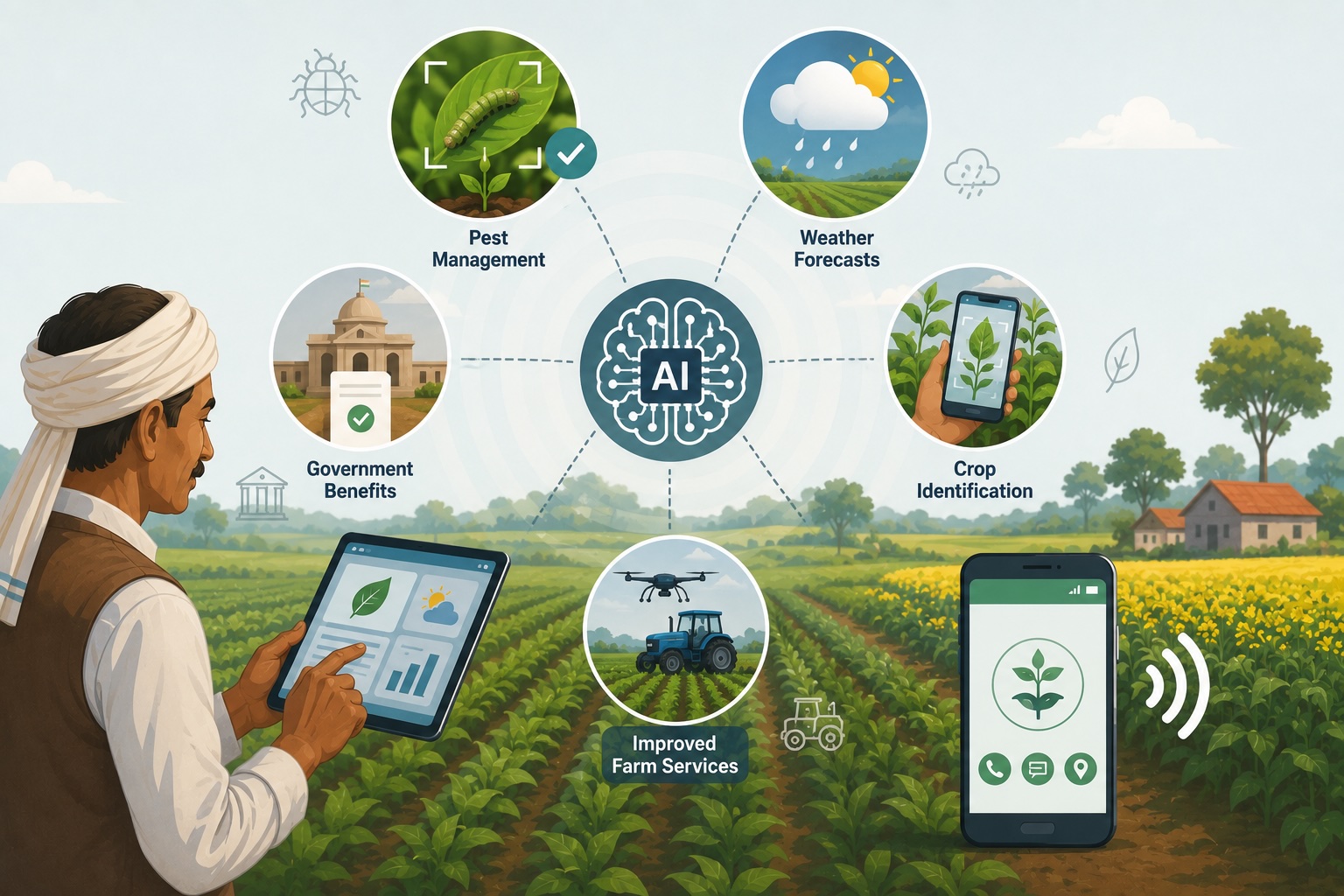
India is expanding the use of artificial intelligence in agriculture to help farmers manage pests, access weather forecasts, identify crops, receive government benefits, and improve farm services. However, the government said it has not yet carried out a comprehensive assessment of the impact of these AI-based technologies.
The Ministry of Agriculture and Farmers Welfare said several AI projects are now operating under the Digital Agriculture Mission. The program supports states in adopting technologies such as artificial intelligence, machine learning, blockchain, the Internet of Things, and robotics.
“The government also provides technical assistance and financial support for human resources to the [states and union territories] for implementing the projects and capacity-building to enhance farmers’ access to AI-enabled technologies and digital services, including small and marginal farmers,” minister of state for agriculture and farmers welfare, Ramnath Thakur, informed in a written reply in the Rajya Sabha, the upper house of India’s bicameral Parliament.
However, funding for digital agriculture declined in 2026-27 compared with the previous year.
Data showed that Rs 502.40 crore (about US$52.3 million) was allocated for digital agriculture initiatives, including AI projects, in 2026-27. Of this, Rs 364.62 crore (US$38 million) has been used so far. In 2025-26, the allocation was Rs 758.56 crore (roughly US$79 million), with Rs 596.10 crore (about US$62 million) utilized. The government did not explain the reason for the lower allocation in its response to Parliament, making it unclear whether the reduction reflects the completion of earlier investments, a shift in spending priorities, or other factors.
Building smarter farms with AI
The biggest significance of these AI initiatives is that they can make farming more productive, efficient, and resilient at a time when climate change is increasing risks for agriculture. AI-powered pest detection and weather forecasts can help farmers act earlier, reduce crop losses, lower production costs, and improve yields. Digital platforms that provide real-time advice, market prices, and access to government schemes can also help farmers, especially smallholders, make better decisions and receive support more quickly.
For consumers, healthier crops and lower farm losses could lead to more stable food supplies and reduce the risk of sharp price increases caused by pest outbreaks or extreme weather. However, the long-term benefits remain uncertain because the government has not yet carried out a comprehensive assessment of how these AI tools have affected farm incomes, productivity, or food security.
“No specific assessment has been undertaken by the government to comprehensively evaluate the impact of AI-based technologies,” Thakur informed in the written reply.
Why these AI tools matter
One of India’s largest initiatives is the National Pest Surveillance System (NPSS). The AI-powered platform helps detect pest attacks early by analyzing images uploaded by farmers and extension workers. According to the Ministry of Agriculture & Farmers Welfare, it is currently used by more than 10,000 extension workers and supports 73 crops and 436 types of pests. The government said the system helps farmers reduce crop losses caused by pest outbreaks, which are becoming more common due to climate change.
The India Meteorological Department also provides AI-based weather and monsoon advisories. These location-specific forecasts help farmers decide when to sow, irrigate, and harvest crops. The service has reached about 52.8 million farmers.
Another major project is BharatVistaar, an AI-powered digital public platform for agriculture. It offers real-time farming advice, weather updates, mandi prices, pest and disease identification, soil health recommendations, and information on 18 central government schemes. The platform has served more than 300,000 farmers and answered over 7.2 million farmer queries.
BharatVistaar is available through a website, mobile app, AI chatbot, and telephone service. The chatbot, website, and app support 10 languages, while the telephone service is currently available in Hindi and English.
The government said it also provides technical and financial support to states and union territories to build digital agriculture systems and improve access to AI-enabled services, including for small and marginal farmers.
These initiatives matter because they bring AI tools directly into everyday farming, helping farmers make faster and more informed decisions. If widely adopted, these technologies could improve farm productivity, strengthen resilience to climate change, and make India’s food supply more stable.