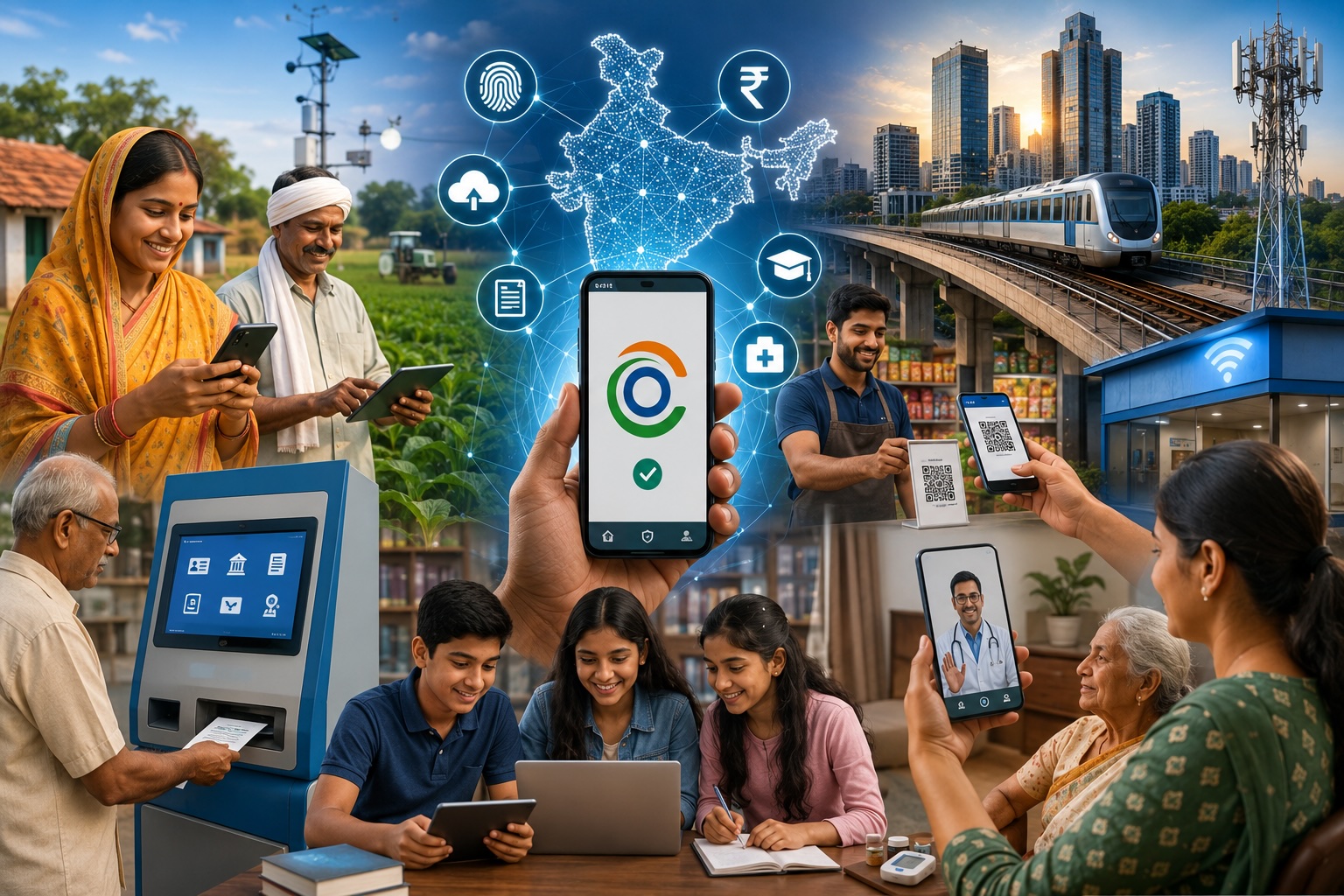
On July 1, India commemorated the 11th anniversary of the Digital India programme, highlighting a decade-long shift in how citizens access government services, make payments and use technology in daily life.
Launched in 2015, the initiative aimed to expand internet access and move public services online. Over time, it has become the backbone of India’s digital public infrastructure, enabling services across banking, welfare delivery, healthcare and education to be accessed digitally by millions of users.
The digital economy currently accounts for an estimated 12–14% of India’s gross domestic product (GDP), according to official estimates, and is expected to contribute around one-fifth over the next decade, as more services move online and adoption deepens. While challenges around inclusion, infrastructure gaps and cybersecurity remain, policymakers see the next phase as one where digital infrastructure is treated as a foundational utility — quietly powering everything from payments and welfare delivery to innovation and enterprise growth across the country.
“Today, we mark 11 years since the Digital India initiative was launched. This initiative has redefined governance, empowered citizens and accelerated all-round development. It has touched every aspect of life,” India’s Prime Minister, Narendra Modi, said.
“From seamless digital payments and direct benefit transfers reaching beneficiaries with transparency to the expanding digital public infrastructure, technology has become a powerful instrument for furthering ‘Ease of Living,’” Modi stated.
Officials say the programme has helped reduce dependence on paperwork and in-person processes, while expanding access to services in rural and semi-urban areas as connectivity improves.
As the programme enters its second decade, policymakers say the focus is shifting from building digital systems to integrating them more deeply across sectors. Future priorities include expanding interoperability between platforms, improving service delivery through automation, and increasing the use of data-driven systems in governance, agriculture and education. Officials say the long-term goal is to position digital infrastructure as a core utility, similar to roads or electricity, underpinning economic activity and public services across the South Asian nation.
“Our strides in the digital world have ensured that India is making rapid progress in emerging technologies such as AI, semiconductors, quantum computing and more. This too will open new avenues for growth and opportunity. Our focus will remain on creating a future where technology serves humanity, empowers every citizen and drives sustainable development,” Modi added.
Payments, infrastructure expansion
A key outcome of the digital push has been the rapid growth of India’s digital payments ecosystem. The Unified Payments Interface (UPI), the country’s flagship real-time payments system, has become widely used for retail transactions and is now among the largest such systems globally in terms of volume.
UPI and other digital payment systems have played a central role in shifting everyday transactions away from cash. The system is now used across urban and rural areas for small-value payments as well as larger retail transactions.
India has also begun exporting elements of its digital public infrastructure model to other countries. The government has signed cooperation agreements with multiple countries to share systems related to digital identity, payments and data exchange. The UPI is now operational in several international markets, including Singapore, the United Arab Emirates, France and Sri Lanka, according to official data.
Platforms such as Aadhaar, DigiLocker and other government digital services are also being studied by other countries as models for large-scale digital governance systems.
The Indian government has also promoted digital infrastructure as a platform for financial inclusion, bringing more users into formal banking and payment systems through low-cost mobile-based tools.
India’s electronics manufacturing sector has also expanded alongside the digital push. Government data claims production has risen significantly over the past decade, supported by policy incentives and investment aimed at strengthening domestic supply chains. Electronics production has increased from ₹1.9 lakh crore (about $20 billion) in FY2014-15 to about ₹12 lakh crore (about $127.7 billion) as of March 2026, according to government data.
“Digital India has taken the wave of innovation to all parts of India, especially villages, Tier-2 and Tier-3 cities. Young entrepreneurs, startups and innovators from every corner of the country are creating solutions to the pressing challenges that our planet faces,” Modi said.
“This Digital India initiative has strengthened education, healthcare, agriculture, commerce and public service delivery, making governance more transparent, efficient and accessible,” he informed.
Education, public services move online
Digital platforms are increasingly being used to deliver public services beyond financial transactions. The DIKSHA platform, used in school education, now has more than 20 million registered users and provides digital textbooks, teacher training materials and interactive learning content. It is also being used to support accessible education through features such as sign language content and mobile-based learning tools.
Higher education platforms such as SWAYAM and SWAYAM Prabha have expanded access to courses and lectures through online and broadcast formats. SWAYAM offers thousands of courses from secondary to postgraduate levels, while SWAYAM Prabha delivers educational programming through dedicated television channels for areas with limited internet access.
In agriculture, the government’s AgriStack initiative is being developed as a data platform to integrate farmer, land and crop information. Officials say it is intended to improve access to credit, insurance and subsidies, while supporting digital advisory services for farmers.
For consumers, the impact of Digital India is increasingly visible in everyday convenience and access. Tasks that once required paperwork, queues and multiple visits can now be completed in minutes on a phone — from receiving government benefits and paying bills to booking services and accessing learning or healthcare tools. Digital payments have reduced reliance on cash, while online platforms have made services more transparent and easier to track. As these systems become more integrated, the overall direction points toward a smoother, faster and more inclusive experience of public services and everyday transactions.